




- Stock: In Stock
- Model: 197x98x63-gr
- Description
- Problem & Solution
- How It Works
- Material & Warranty
- Use Cases
- In the Range
- Environment
- FAQ
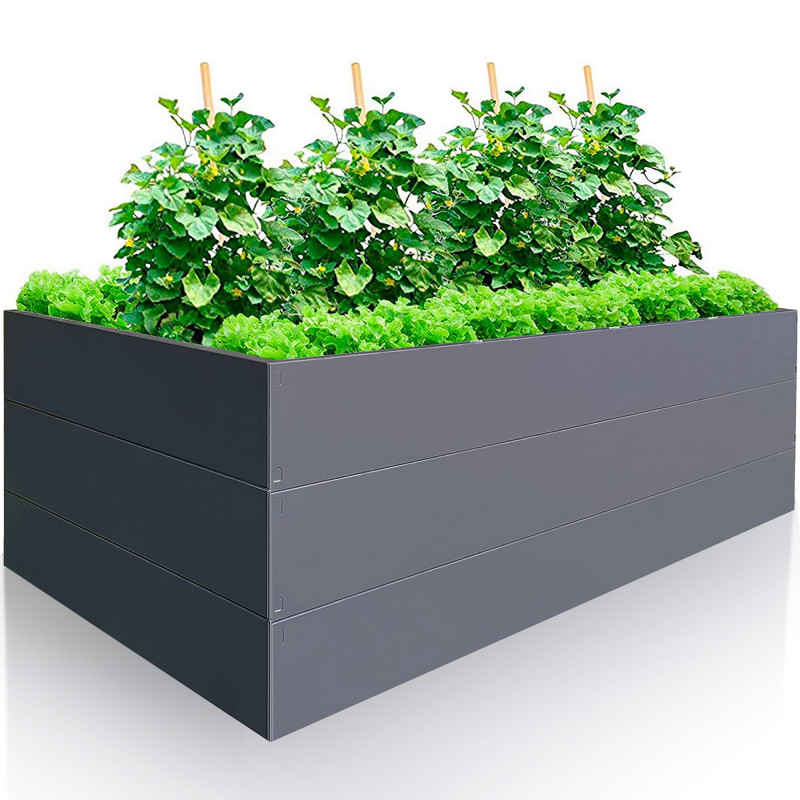
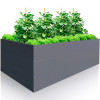
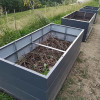
The GARTENDEK Raised Bed 197×98 Grey is the flagship large-format raised garden bed in the GARTENDEK range — a permanent outdoor planting structure built from galvanized structural steel with an anthracite grey (RAL 7016) polymer finish. Designed for maximum growing volume and clean garden architecture, it combines a 63 cm ergonomic working height with approximately 1,220 litres of growing capacity — the largest in the lineup — across a generous 197×98 cm footprint (marketed as 200×100).
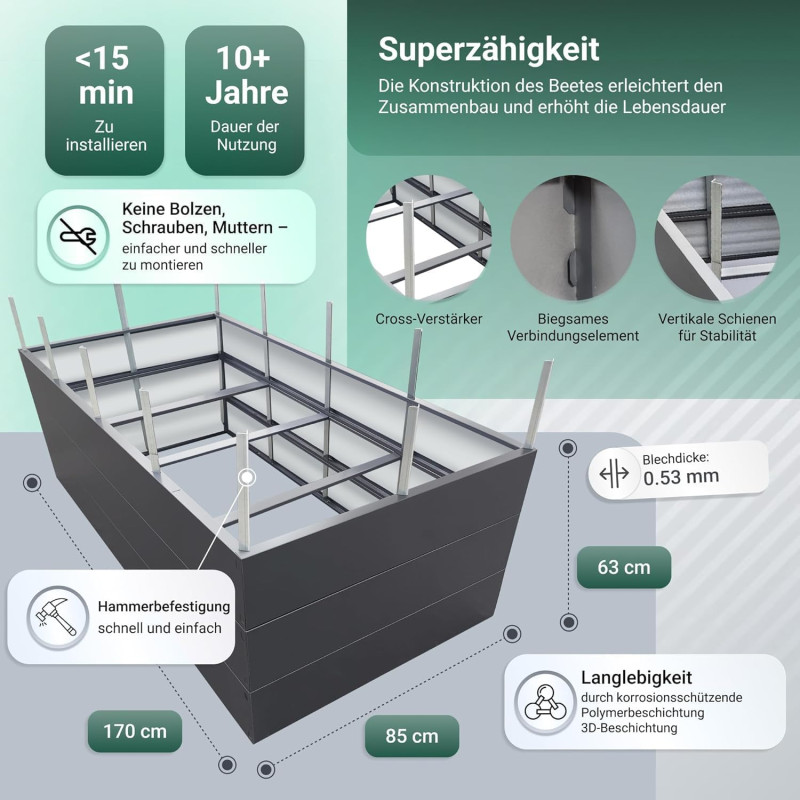
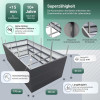
Assembly is completed by one person without power tools in under 30 minutes. The panel connector system snaps together by hand; galvanized steel stakes are driven ~35–40 cm into the ground with a hammer to anchor the structure. The kit includes everything needed: panels, connectors, stakes, a mole mesh base, protective gloves, and illustrated instructions. No additional purchases are required.
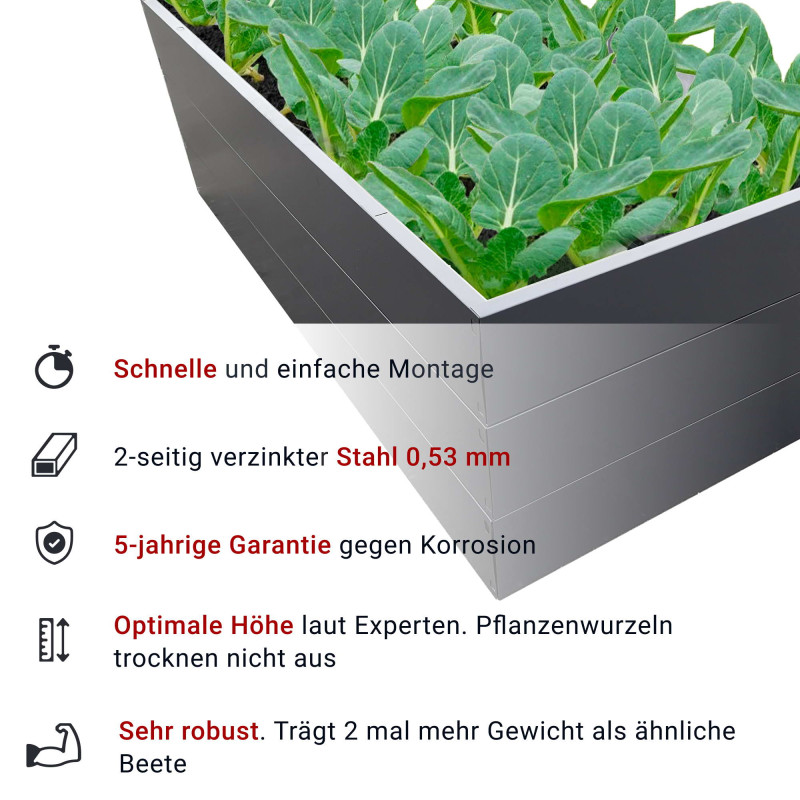
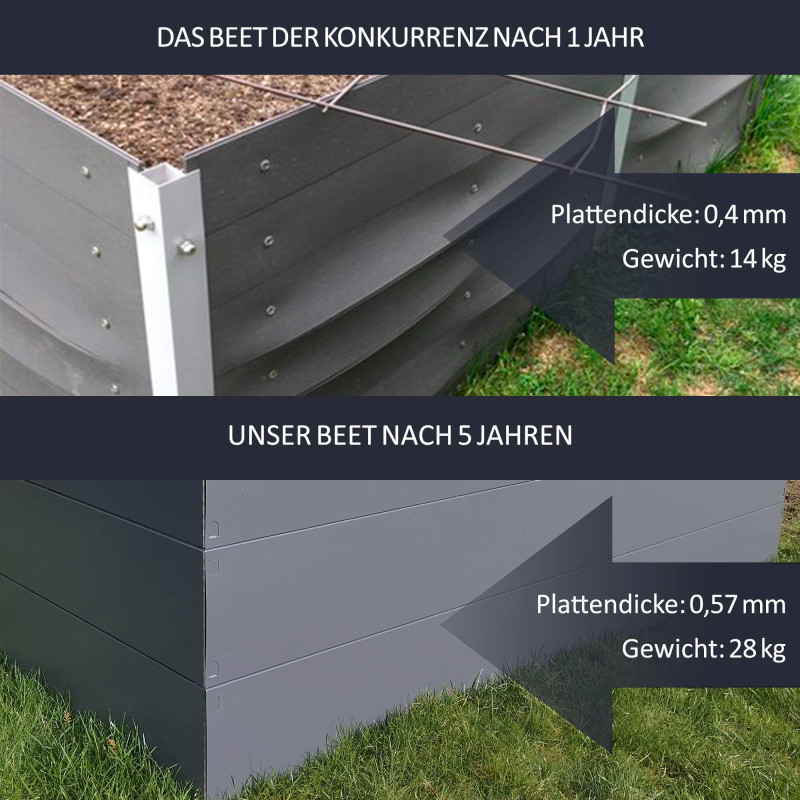
The finish is a multi-layer system: S250GD construction-grade steel core, Z275 hot-dip galvanization (275 g/m²), passivation layer, primer, and a 35 µm SP35 polyester topcoat in RAL 7016 matt. The result is a structure that does not rust, warp, crack, or fade — engineered for 10+ years of permanent outdoor use without maintenance. At nearly 2 metres in length, the anthracite grey bed becomes the defining architectural element of the garden — a bold, modern, timeless structure that pairs naturally with stone, gravel, concrete, and contemporary landscaping.
Growing vegetables, herbs, and flowers at ground level means bending, kneeling, and working in an uncomfortable position for extended periods. For older gardeners, anyone with back or knee issues, or simply those who want a more organised garden, this becomes a persistent barrier to productive and enjoyable cultivation.
Wooden raised beds solve the ergonomic problem but introduce another: decay. Untreated timber rots within 2–3 seasons. Pressure-treated wood lasts longer but still warps, cracks, and greys over time. Annual staining or oiling becomes a maintenance ritual. After 3–5 years, the structure typically needs replacement — soil must be removed, the frame rebuilt, and the growing cycle interrupted. At the 200×100 cm format, the volume of soil to remove and the cost of replacement are substantial.
Cheap metal raised beds appear as an alternative, but many require tools and drilling for assembly, use thin untreated sheet metal that corrodes quickly, and lack proper ground anchoring — leading to wall deformation under the lateral pressure of wet soil over time. At the large 200×100 format, the forces involved are even greater, making poor anchoring a structural risk rather than a cosmetic issue.
The GARTENDEK Raised Bed 197×98 Grey occupies the position that none of these alternatives can reliably hold at the large format: a tool-free, one-person assembly; construction-grade galvanized steel with a five-layer coating system; permanent ground anchoring with structural steel stakes; and a 10+ year service life with zero maintenance. The result is a full-size ergonomic growing system that also functions as a major garden architecture element — not a seasonal accessory that needs to be replaced every few years.
The Raised Bed 197×98 Grey is delivered as a flat-packed kit in a single box (packaging: 200 × 27 × 22 cm, gross weight 25 kg). All components are included.
Assembly is performed by one person. Metal wall panels connect via a snap-fit connector system — no screws, bolts, or drilling required. The mole mesh is laid at the base to prevent underground pests from accessing the growing area. Steel stakes (1.0 mm galvanized steel) are then driven approximately 35–40 cm into the ground using a hammer or mallet. Protective gloves and illustrated instructions are included in the kit. First-time assembly: under 30 minutes. Reassembly: 10–15 minutes.
Structural anchoring is the key engineering principle. The stakes are not optional accessories — they are load-bearing structural elements integral to the design. At ~1,220 litres of wet soil capacity, the lateral pressure on the walls is substantial. Once driven into the ground, the stakes lock the geometry of the bed and prevent wall deformation under seasonal freeze-thaw cycles, soil saturation, and compaction. The stakes are designed for working under soil load, not wind protection.
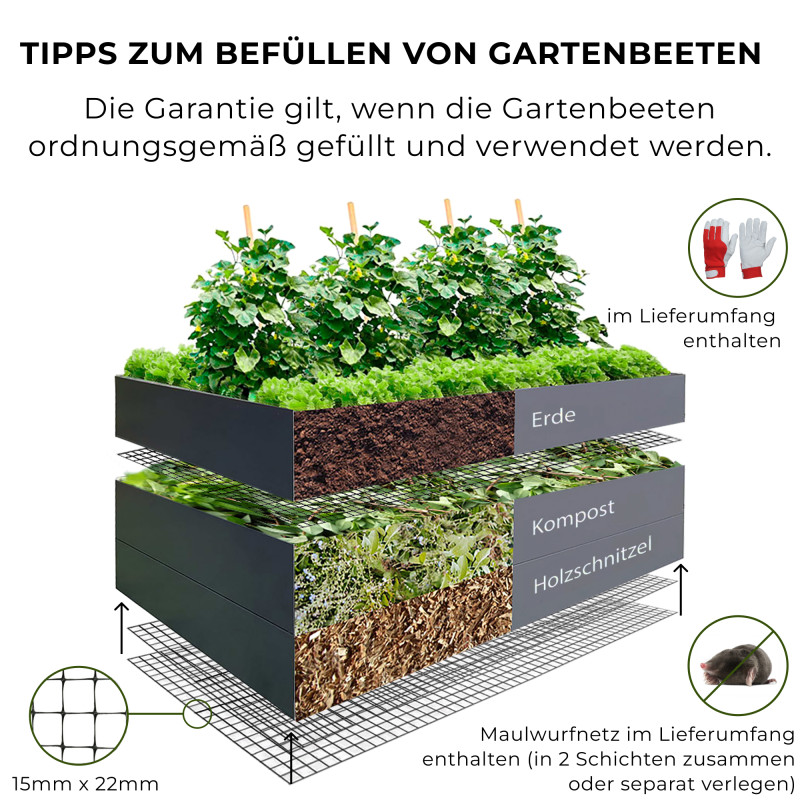
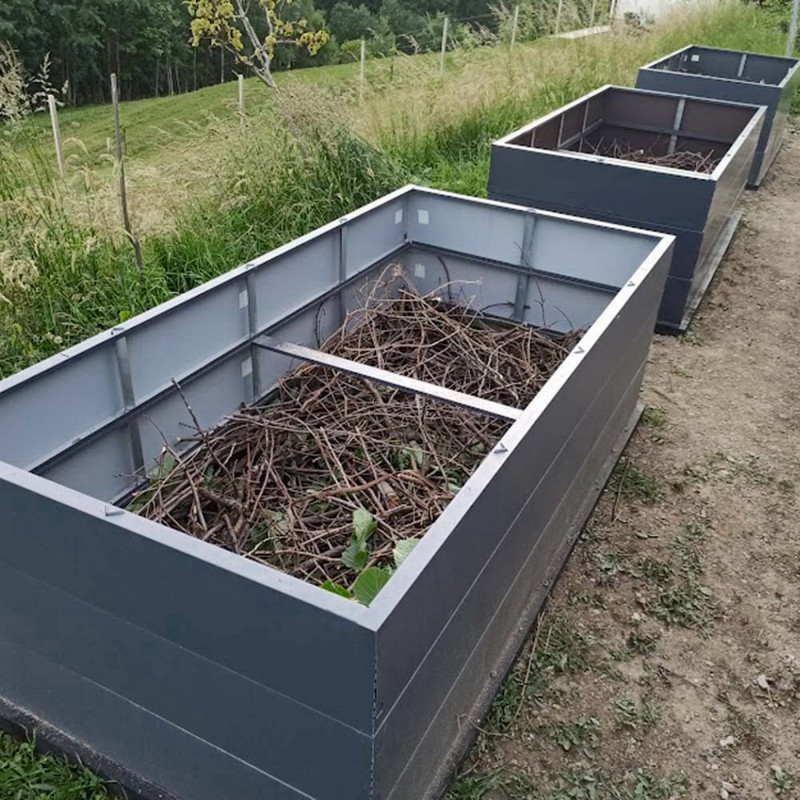
Filling follows a three-layer system:
- Drainage layer (~21 cm) — branches, wood chips, or coarse organic material
- Organic layer (~21 cm) — compost, leaves, mowed grass, or biodegradable material
- Planting layer (~21 cm) — garden soil or specialised raised bed mix
The ~1,220 litre figure is the geometric internal volume of the structure — not the volume of soil alone. With multi-layer filling, a significant portion is occupied by drainage and organic materials.
Settling is natural. Organic materials in the lower layers decompose and compact over time, most noticeably during the first season and the first 1–2 years. Topping up with 20–30% of planting-layer soil may be required.
Seasonal behaviour is passive. The galvanized steel structure does not absorb water, does not warp, and does not degrade from UV exposure. The bed remains installed year-round — no seasonal dismantling, covering, or storage is required.
Load limitations — the structure is designed for soil pressure under standard multi-layer filling. Filling with heavy mineral materials (stone, gravel, construction materials) does not correspond to the product's intended use and may cause excessive structural loads.
Installation limitation — the bed is designed exclusively for natural soil. It is not suitable for concrete, tiles, paving, decking, or any surface where stakes cannot be driven into the ground.
The Raised Bed 197×98 Grey is constructed from galvanized structural steel S250GD (EN 10346) — the same class of material used in commercial roofing and façade systems across Europe. This is not decorative sheet metal; it is construction-grade steel chosen for its load-bearing strength and long-term weather resistance.
The protection system is a five-layer stack:
| Layer | Specification | Function |
| Steel core | S250GD (structural grade) | Load-bearing strength, deformation resistance |
| Zinc coating | Z275 hot-dip, 275 g/m² | Long-term anti-corrosion protection |
| Passivation layer | — | Additional oxidation resistance |
| Primer layer | — | Finish coating adhesion |
| SP35 finish | Polyester, 35 µm — RAL 7016 Grey matt | UV, weather, mechanical protection + colour |
SP35 coating performance data:
| Parameter | Value |
| UV resistance | QUV test (UVA + H₂O) — 2,000 hours |
| Corrosion resistance | Category C3 (EN ISO 12944-2) |
| Impact resistance | 18 Joules |
| Scratch resistance (Clemen) | ≥ 1.5 kg |
| Coating adhesion (T-bend) | ≤ 1T |
| Bending resistance | ≤ 2T |
Standards: EN 10169 (organically coated steel), EN 10143 (dimensional tolerances), EN 10346 (hot-dip galvanized steel), EN 14782 (self-supporting metal sheet for roofing/cladding), EN ISO 12944-2 (corrosion classification).
Compared with typical alternatives:
| Criterion | GARTENDEK 197×98 Grey | Wooden raised bed (200×100) | Cheap metal raised bed | Concrete / stone raised bed |
| Weight (comparable size) | 22.2 kg | 40–80 kg | 15–30 kg | 100–300+ kg |
| Service life | 10+ years | 2–5 seasons | 1–4 years | 10+ years |
| Assembly | Tool-free, ~30 min, 1 person | Tools needed, 1–2+ hours | Tools often required | Professional installation |
| Maintenance | ✅ None | ❌ Annual staining / oiling | ⚠️ Variable | ✅ None |
| Corrosion / rot | ✅ No (5-layer coating) | ❌ Rots | ⚠️ Often corrodes | ✅ No |
| Wall deformation | ✅ No (stake anchoring) | ⚠️ Warps over time | ⚠️ Common without anchoring | ✅ No |
| Ergonomic height | 63 cm (standing) | Variable (often 30–40 cm) | Variable | Variable |
| Mole mesh | ✅ Included | ❌ Separate purchase | ❌ Often not included | ❌ Separate |
| Visual quality | RAL 7016 architectural matt | Greying / cracking over time | Industrial / basic finish | Natural stone / masonry |
| Growing volume | ~1,220 L | ~1,200 L (varies) | Variable | Variable |
| Production | EU (under VSDN d.o.o. control) | Variable | Predominantly China | Local / artisan |
The GARTENDEK Raised Bed 197×98 Grey occupies a deliberate position: lighter and easier to assemble than concrete or stone, far more durable and visually refined than wooden or budget metal alternatives, and uniquely combining a five-layer construction-grade coating with a tool-free assembly system — all in the largest format available in the range.
Maintenance is zero. No painting, staining, oiling, sealing, or chemical treatment is ever required.
Full-size kitchen garden: a homeowner with a medium or large garden installs one 197×98 bed to grow the full seasonal rotation: tomatoes, peppers, courgettes, salads, herbs. The ~1,220-litre volume and ~1.93 m² footprint support intensive vegetable production from spring through autumn — a complete kitchen garden in a single unit.
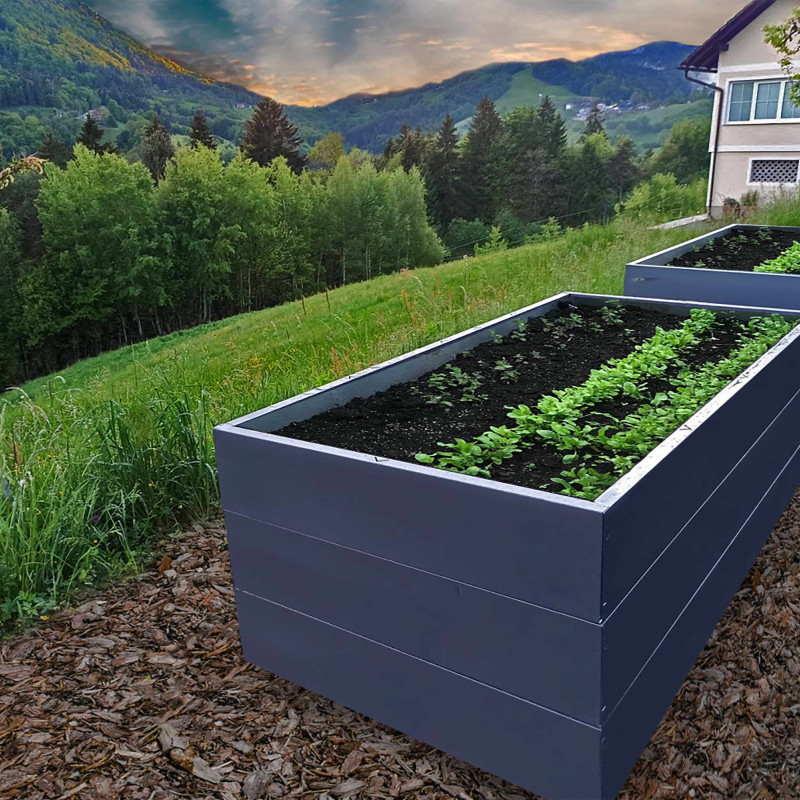
Central landscape structure in a modern garden: placed in the centre of a gravel-covered or stone-edged garden, the anthracite RAL 7016 bed becomes the defining architectural element. Its nearly 2-metre length and clean grey lines create a bold modern focal point that organises surrounding garden zones without competing visually with the plants.
Serious vegetable grower (self-sufficiency): a household aiming for partial food self-sufficiency uses the maximum ~1,220-litre volume for intensive mixed planting. Combined with a second bed, the setup covers most seasonal vegetable needs for a family of 2–4.
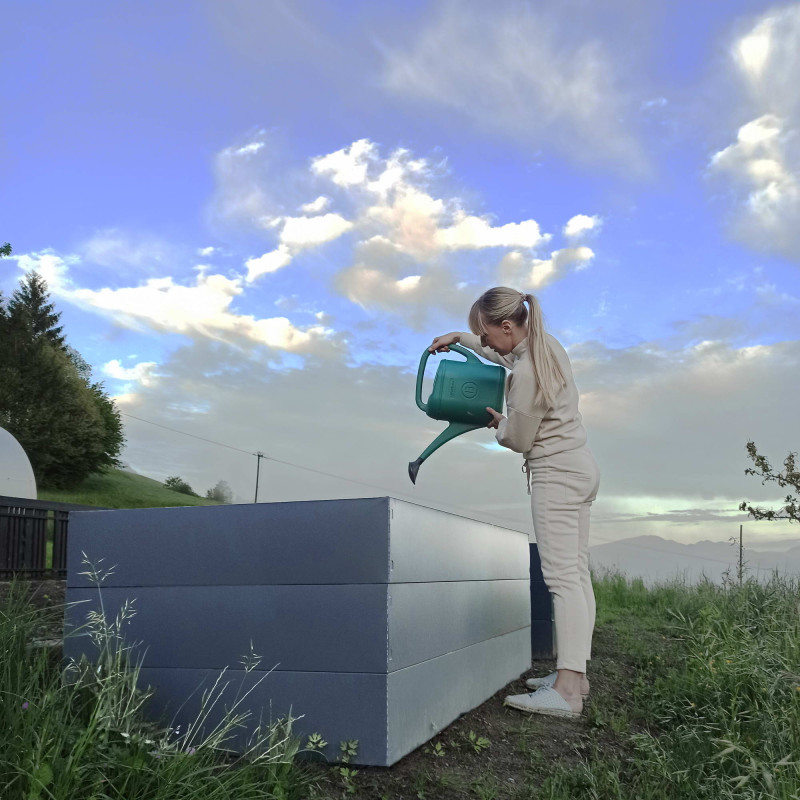
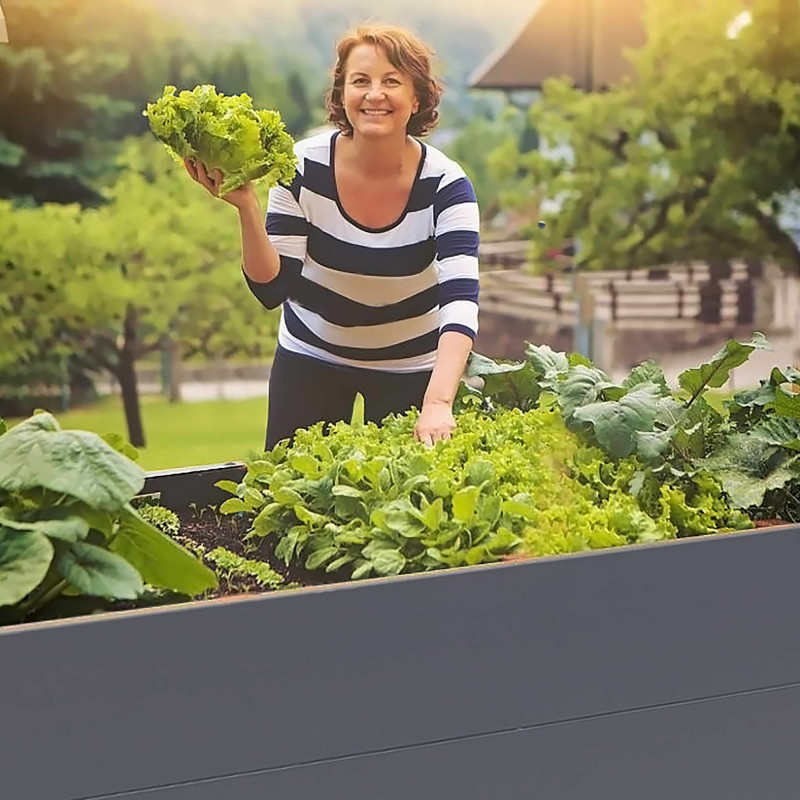
Elderly or mobility-limited gardener: a retiree (65+) sets up the bed alone in under 30 minutes without power tools. The ergonomic 63 cm height eliminates knee and back strain. Protective gloves are included for safe handling. All plants are accessible from the edges without stepping into the bed.
Replacing a rotted wooden bed (200×100): a gardener whose wooden raised bed (commonly 200×100 cm) has deteriorated after 2–3 seasons replaces it with the GARTENDEK metal alternative — matching footprint, no more annual treatment, 10+ year lifespan. The anthracite grey finish delivers a cleaner, more contemporary look than the previous weathered wood.
Community or educational garden: schools, allotments, or public spaces install the large-format beds for maximum growing area per unit with low maintenance. When placed in public areas, three conditions must be observed: correct scenario for the location, compliance with local safety regulations, and use corresponding to the product's intended purpose. EU manufacture and 10+ year lifespan reduce long-term cost.
The Raised Bed 197×98 Grey is the flagship large-format model (L) of the GARTENDEK raised bed range — the biggest model in the anthracite RAL 7016 colour line. It offers ~1,220 litres of growing volume — the maximum in the lineup — in a 197 × 98 × 63 cm footprint (marketed as 200×100) at €277.56.
Full GARTENDEK Raised Bed product matrix (4 models):
| Size | Grey RAL 7016 | Wood Effect |
| 170×85×63 cm (M) | €246.34 | €249.49 |
| 197×98×63 cm (L) | ← THIS MODEL — €277.56 | €279.97 |
What is identical across all models:
- Height: 63 cm
- Material & coating: S250GD + Z275 + SP35
- Wall thickness: 0.50 mm
- Stake thickness: 1.0 mm
- Kit contents: panels, connectors, stakes, mole mesh, protective gloves, instructions
- Assembly method: tool-free, one person
- Service life: 10+ years (under SSOT §2.15 conditions)
What varies:
- Size and volume: M ~910 L vs L ~1,220 L
- Finish: RAL 7016 Grey matt (anthracite) vs Wood Effect (light oak imitation)
- Price
- Packaging and weight
Choose the 197×98 Grey when:
- Maximum growing volume is the priority (~1,220 litres — largest in the range)
- A full-size kitchen garden in a single unit is needed (~1.93 m²)
- Modern architectural anthracite aesthetic is preferred
- Replacing an existing 200×100 wooden raised bed
- Garden space accommodates a 197×98 cm footprint
Consider a different model when:
- Garden space is limited or compact — choose 170×85 Grey (~910 L, €246.34)
- Natural warm aesthetic preferred over anthracite — choose 200×100 Wood Effect (€279.97)
- Both compact AND warm aesthetic — choose 170×85 Wood Effect (€249.49)
- Lower entry price point is important — choose 170×85 Grey (€246.34)
Decision rule: RAL 7016 Grey is the modern, architectural choice. Wood Effect is the natural, warm choice. Both share identical engineering, materials, and performance. The choice is purely aesthetic. For size: choose 170×85 (M) if space is limited or ~910 L is enough; choose 200×100 (L) for maximum growing volume and full-format kitchen gardening.
Environment — Metal Raised Garden Beds (GARTENDEK)
1. Carbon Footprint (Production & Logistics)
The carbon footprint of GARTENDEK metal raised garden beds is determined by three factors: steel production, manufacturing location, and logistics distance.
Materials: The product uses construction-grade galvanized steel S250GD with Z275 zinc coating (≥275 g/m²) and SP35 organic polymer finish. Steel production is energy-intensive, but the long service life (10+ years) significantly reduces the carbon footprint per year of use compared to disposable alternatives.
Production: Manufacturing takes place within the EU under GARTENDEK quality control. European production significantly reduces transport distance compared to non-EU alternatives.
Logistics: Each bed is shipped in flat-pack cardboard packaging. Product weight ranges from 19–25 kg depending on model (M: ~19 kg, L: ~25 kg). Courier delivery within the EU typically generates 15–30 kg CO₂e per shipment depending on size and distance.
Numerical estimate (category average): For a medium-sized bed (170×85 cm), the estimated carbon footprint from production and delivery within Central Europe is approximately 25–40 kg CO₂e per unit.
2. Zero Plastic Packaging
GARTENDEK metal raised garden beds are shipped without single-use plastic packaging.
Primary packaging: All components (steel panels, connectors, stakes, mole protection mesh, assembly gloves) are packed in a cardboard box.
Secondary packaging: The cardboard box is not wrapped in plastic film. No stretch film, no PVC ties, no plastic bags.
Customer action: After receiving the bed, the user removes the components from the cardboard box. The box is recyclable as paper/cardboard waste.
Cardboard box disposal: The box can be:
- Recycled as paper/cardboard waste
- Composted (if shredded, as brown material)
- Used as protective covering for garden paths
Plastic content per shipment: 0% — no plastic packaging is used.
3. Water Conservation
The product itself does not consume water during use. However, water conservation is relevant in two ways:
Production: Steel manufacturing uses water for cooling and processing. GARTENDEK works with EU suppliers who follow industrial water recycling standards.
Use phase (gardening): Raised beds improve water efficiency compared to ground-level planting. The contained soil volume reduces runoff and allows targeted irrigation. The 63 cm working height also reduces water waste from overspray during hand watering.
Comparison to alternatives: Wooden raised beds often require water-intensive treatments (stains, sealants) to prevent rot. GARTENDEK steel beds require no such treatments.
Verdict: The product supports water-efficient gardening practices and requires no water for maintenance.
4. Food Waste Reduction
GARTENDEK raised garden beds are directly involved in food production — they are designed for growing herbs, vegetables, and berries.
Local food production: By enabling home growing, the beds reduce dependence on long supply chains. Fresh produce can be harvested steps from the kitchen, eliminating transport losses and retail waste.
Harvest what you need: Home growers harvest only what they need, when they need it — significantly reducing the 30–40% waste typical of store-bought greens.
No soil contamination: The steel is galvanized and coated with food-safe polymer (SP35). The material does not leach into soil and is safe for growing edible plants.
Quantified impact: A single 170×85 cm bed can produce 30–50 kg of vegetables per season, directly replacing store-bought produce and its associated food waste.
5. Product Lifecycle
Declared service life: 10+ years of outdoor use under normal conditions (temperature range −30 °C to +60 °C, UV exposure, rain, snow, wind, soil pressure).
Design philosophy: The bed is engineered as a permanent garden structure — not a disposable seasonal item. The multi-layer protection system (S250GD steel + Z275 zinc + SP35 coating) is designed to remain structurally stable for a decade or more.
Maintenance requirements: None. No seasonal treatment, no repainting, no sealing, no waterproofing. Unlike wood, the steel does not rot, warp, or require chemical preservatives.
Failure modes (end of life): The coating may eventually show cosmetic wear (scratching, fading) after 10+ years. Structural failure is unlikely under normal use. The steel does not biodegrade or rot.
Obsolescence: The bed does not become functionally obsolete. It can be disassembled, moved to a new location, and reassembled at any time. All components are reusable.
6. Transport Packaging
Primary packaging: Cardboard box (corrugated cardboard, typically recycled content). Box dimensions: 100×70×15 cm (M) or 110×75×18 cm (L).
Packaging weight: Cardboard adds approximately 2–3 kg to the shipment.
Packaging materials:
- Corrugated cardboard (recyclable, compostable)
- Paper instructions (recyclable)
- No plastic, no foam, no void fill
Logistics class: Standard courier (DPD, GLS, national postal services) for all models. Flat-pack design maximizes shipping efficiency — up to 4 beds per pallet.
Space efficiency: Flat-pack packaging reduces transport volume by approximately 80% compared to assembled beds. Void space is minimal.
7. End‑of‑Life & Recyclability
Material composition:
- Steel core (S250GD) — fully recyclable as scrap metal
- Zinc coating (Z275) — recovered during steel recycling
- SP35 polymer coating — burned off during steel recycling (energy recovery)
- Connectors and stakes — same steel, fully recyclable
- Mole protection mesh — recyclable plastic (PP/PVC) or metal depending on batch
- Assembly gloves — standard cotton/polyester, disposable as general waste
Current recyclability status: The steel components are fully recyclable through standard metal recycling streams. Steel is the most recycled material in the world (recycling rate >85% in the EU). The zinc and polymer coatings are removed during the steel recycling process (burned off or recovered).
Responsible disposal options:
- Metal recycling (preferred) — disassemble the bed, separate steel from other materials, deliver to scrap metal facility
- Reuse (best option) — disassemble and sell/give away for continued use
- Landfill (non‑hazardous) — only as last resort; the material is inert and does not leach toxins
Comparison to alternatives:
- Wooden beds — not recyclable (treated wood is hazardous waste), end up in landfill or incineration
- Plastic beds — recyclable in theory, but low-quality plastics often end up in landfill
- Concrete beds — crushable as aggregate, but significantly heavier and less resource-efficient
Circular economy potential: Steel beds can be recycled indefinitely without loss of material properties. GARTENDEK encourages reuse and recycling at end of life.
8. Summary Table (Category Ranges)
| Parameter | Range / Value |
|---|---|
| Product name | GARTENDEK Metal Raised Garden Bed (M: 170×85 cm, L: 197×98 cm) |
| Declared service life | 10+ years |
| Weight (product only) | 19–25 kg (M: ~19 kg, L: ~25 kg) |
| Weight with packaging | 21–28 kg |
| Packaging dimensions | 100×70×15 cm (M) or 110×75×18 cm (L) |
| Carbon footprint estimate (production + delivery within EU) | 25–40 kg CO₂e |
| Plastic packaging | 0% — no plastic packaging |
| Water consumption during use | 0 L (no irrigation required for the structure itself) |
| Recyclability (current) | Steel components: fully recyclable (metal recycling stream) |
| Material leaching into soil | None — galvanized steel with polymer coating is inert and food-safe |
| Food‑safe for growing edible plants | Yes — SP35 coating is food-safe, no toxic leaching |
9. EU Environmental Frameworks
REACH (EC 1907/2006): All materials used (steel S250GD, zinc Z275, SP35 polymer coating) comply with REACH regulations. No SVHC (Substances of Very High Concern) are intentionally added. The coating is free from lead, cadmium, and other heavy metals.
CE marking (Construction Products Regulation CPR — EU 305/2011): Raised garden beds are not classified as construction products under CPR. They are garden structures and do not require CE marking.
EU Ecolabel (optional): The product does not carry EU Ecolabel certification. However, its long service life and full steel recyclability align with Ecolabel principles.
Waste Framework Directive (2008/98/EC): The cardboard packaging is classified as non‑hazardous waste (EWC 15 01 01 — paper/cardboard packaging). The steel bed itself, at end of life, is classified as non‑hazardous metal waste (EWC 17 04 05 — iron and steel).
Single‑Use Plastics Directive (SUP — EU 2019/904): The product uses no plastic packaging and therefore falls outside the scope of SUP.
EU Green Deal / Circular Economy Action Plan: The product aligns with durability, repairability, and recyclability principles: long service life (10+ years), no planned obsolescence, fully recyclable steel, and zero plastic packaging. Steel is a priority material in EU circular economy targets.


-90x90.png "Arthur on pedestal (square) black/bronze, 20 cm")
-90x90.png "Arthur on pedestal (square) ivory, 20 cm")

